

Select Country or Region

global

English

Blog Center

Blog Details

What Is the Difference Between Rubber Slurry Pumps and Metal Slurry Pumps?

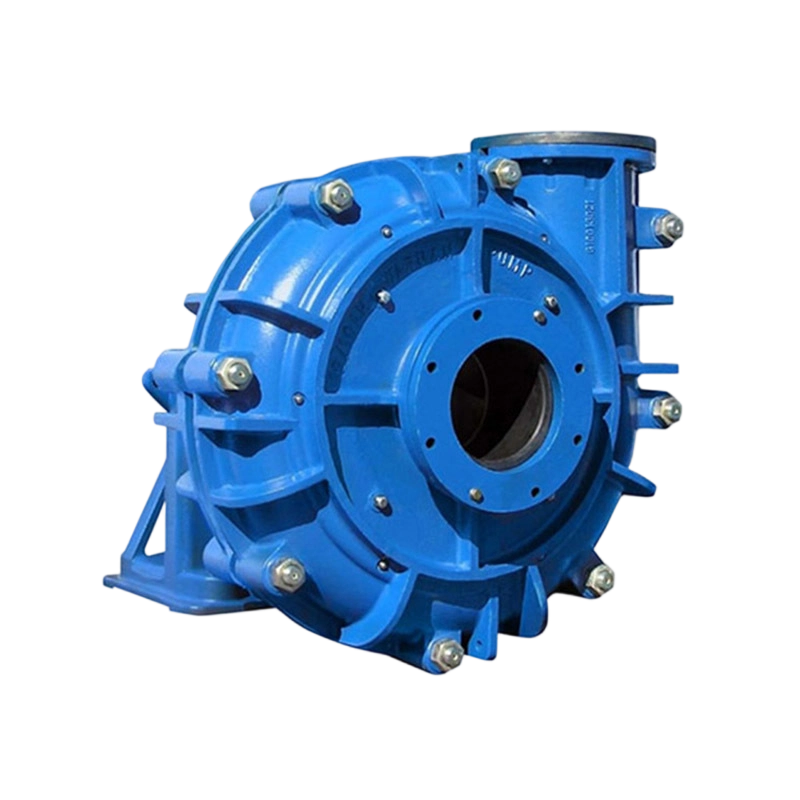
Both rubber slurry pumps and metal slurry pumps can be used to transport slurries containing solid particles, but they are suitable for different media and operating conditions. When selecting, it cannot simply be assumed that rubber is necessarily more wear-resistant or that metal will always have a longer service life.

Rubber wet-end parts are generally suitable for fine-particle abrasive slurries within a certain range, and can also be used for some corrosive media depending on the material type. Rubber linings have a certain degree of elasticity, and worn parts can be replaced according to the product structure.

Metal wet-end parts are typically better suited for working conditions with larger particles, high impact, higher temperatures, or a large amount of sharp particles. However, specific performance still depends on the metal material, particle characteristics, pump speed, and operating conditions.

When choosing between rubber and metal, key considerations should include: maximum particle size; particle sharpness; particle hardness;

solids content and slurry density; medium temperature; pH value and chemical composition; pump speed and duty point; continuous operation time; maintenance and spare parts availability.

For rubber components, attention must also be paid to high temperatures, oily media, special solvents, and chemical compatibility. They should not be used directly with special chemical slurries without material verification.

The most reliable selection method is to provide complete media data, wear photos of the old pump, and operating logs, allowing technical personnel to evaluate rubber linings, metal wet-end parts, or other material solutions.

Company FAQs
FAQ
Here, we answer your frequently asked questions about customization, material selection, and purchasing industrial rubber and wear-resistant components.
Contact Us
What are the common spare parts for rubber slurry pumps?
Common spares include impellers, rubber liners, casings, throatbushes, frame plate liners, shaft sleeves, seal components, and bearing assemblies. Replacements should be confirmed by pump type, model, part number, or drawing.
Can rubber slurry pumps be customized?
Yes. Pumps can be configured or customized based on flow rate, head, rubber lining, sealing type, drive setup, nozzle orientation, and installation requirements.
What are the differences among CLR, CMR, CMCR, CSPR, and CAHR?
Different models suit specific mounting styles and operating conditions: CLR, CMR: For light-abrasion slurry handling. CMCR: For specific slurries like mill underflow. CSPR: For sump or submerged slurry pumping. CAHR: For standard rubber-lined centrifugal pumping applications.
How to select the right rubber slurry pump?
Pump selection requires flow rate, head, medium type, solid content, particle size, medium density, temperature, pH, suction conditions, and operating hours.
What is the purpose of rubber lining?
Rubber linings reduce wear and corrosion on casings and wet ends from specific slurries, ideal for fine-particle, moderate-temperature duties. Material and lining configurations must be confirmed based on slurry concentration, particle size, temperature, and corrosiveness.
What applications are rubber slurry pumps suitable for?
Rubber slurry pumps mainly handle solid-laden slurries, tailings, and mortar. They are widely used in mining, mineral processing, grinding, tailings disposal, and industrial conveying.

Ready to upgrade your
pumping system?

Global Inquiry Hotline

+86 19933037056

Official Email

info@cnminerals.com

Company Address

Block C, MCC Shengshi Plaza, No. 66 Xiangtai Road, Yuhua District, Shijiazhuang City, Hebei Province

Get Free Custom Solution

*
*
File Upload Upload your drawings for a real-time quote